



Release management is a tricky and trying time for most businesses. There are numerous tasks to juggle, each with its own unique specifications and challenges. Indusa has worked with several different software product companies in order to strengthen their software development processes and improve their product release management. As such, we’ve come to realize there are certain strategies businesses can use to make this process easier. We’ve compiled some of our top tips for software product companies looking to ease their release management difficulties.
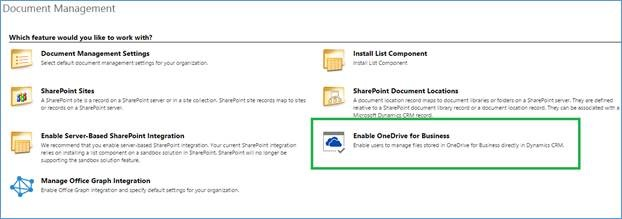
Integrating Dynamics CRM 2016 and OneDrive for Business- Taking Productivity to the Next Level
As organizations make investments to accelerate business outcomes, they continue to look for ways to achieve greater efficiency and productivity while minimizing costs. A significant area where you can use technology to improve business efficiency is by integrating OneDrive for Business with your Dynamics CRM 2016 system. By integrating these two, you can leverage numerous benefits like improved collaboration and increased visibility, augmenting productivity in the long run. Let’s look at the two systems individually and then see why and how integrating them can achieve increased productivity and efficiency.
Topics: CRM, Thought Leadership
Collaboration has undergone an enterprise makeover in recent years. The market has emerged from casual social networking sites like Facebook and Twitter to networking platforms from reputable enterprise players like IBM, Oracle, and SAP. Enterprise-specific social networking has transformed from consumer tailored communication tools to full-fledged business collaboration platforms. As their features and capabilities continue to multiply, these enterprise platforms have the ability to replace not only Intranets, but also knowledge management systems and business portals.
Topics: enterprise mobility, Thought Leadership
Azure vs On-Premises: 4 Scenarios To Help You Make the Most of Your Azure Platform
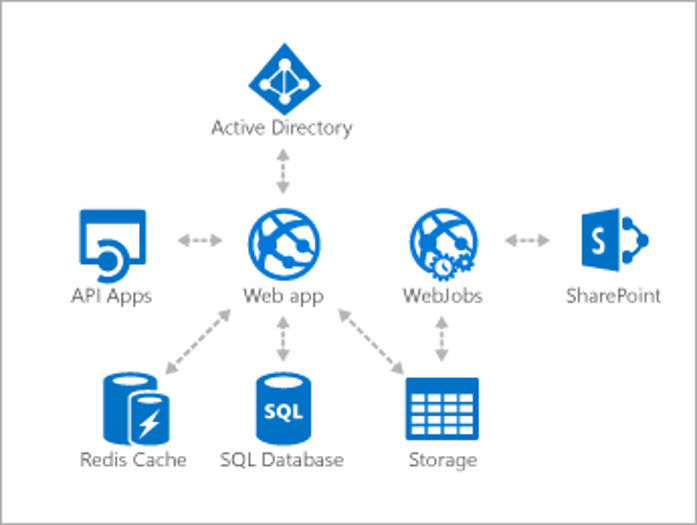
If you are looking to move a part or all of your services to the cloud, now is the time. Microsoft Azure offers an open and flexible cloud platform that enables you to quickly build, deploy, and manage applications across a comprehensive network of data centers, while simultaneously addressing challenges around security and control. Using Azure, you can harness the power of Microsoft’s massive data centers without having to worry about building, managing, or maintaining costly and complex infrastructure, and focus on aspects that really matter to your business. Wondering how Azure can benefit your organization? Let’s look at four key scenarios and see how you can make the most of an Azure platform:
Topics: Cloud Services
Traditionally, ERP software has been run on-premises, requiring expensive service maintenance and imposing strain on IT resources. While working in the cloud not a new approach to ERP software, it has only recently become more mainstream given that it provides a number of benefits; these benefits are especially prevalent when looking at small and medium sized businesses (SMBs) whose resources and infrastructure may have more limitations than larger enterprises. A cloud ERP provider can give SMBs numerous advantages over a traditional, on-premises set up.
Here are 3 reasons why SMBs should switch to a cloud ERP system:
Topics: ERP
Enjoy a Unified Search Experience with SharePoint’s New Cloud Search Service Application
SharePoint has been fueling enterprise collaboration by bringing teams together through a multitude of features like document management, BI, search, and enterprise content management. In order to drive operational excellence, Microsoft has released a new feature as an update for SharePoint called Cloud Search Service Application.
What does the Cloud Search Service Application do? It connects on-premises content with the O365 search index, enabling users to perform searches and view results across both environments. This is particularly important in a hybrid SharePoint scenario where some content resides in the cloud while some remains on-premises. This new search capability helps reduce market resistance, especially among enterprises that are overly cautious storing sensitive content off-premises.
Topics: Office 365, Microsoft SharePoint, Thought Leadership, Cloud Services
Perplexed about the right way to move to the cloud? Well, you’re not alone! Moving to the cloud can be complex if you’ve not planned for it properly. So how do you develop a cloud migration strategy that is aligned with your business goals and objectives? What measures do you take to get the most out of your cloud investment? Where do you begin? The best way to increase the likelihood of a successful migration is to start by outlining steps and developing a migration plan that takes into account all aspects of the migration: business, technology and partner.
Topics: Cloud Services
Wearable Devices and its Contribution to the Enterprise of Things
Wearables. There are high chances you are wearing one right now. Gartner predicts that wearable market is forecast to grow from 70 million units in 2014 to 91 million units in 2016. And this includes not just smart watches but also smart glasses, fitness monitors, chest straps, and other smart garments. With the wearable buzz everywhere, you are probably wondering what the future looks like in consumer and business markets.
Topics: enterprise mobility, Thought Leadership
As more and more businesses discover the benefits of transitioning to the cloud, such as high flexibility, low operational costs, and improved performance and resiliency, the world is experiencing a paradigm shift in the way businesses operate and provide services. With the hype around cloud services, many organizations across the globe are taking initiatives to migrate to the cloud immediately. While there is no denying the fact that cloud services can be tremendously beneficial, a one-size-fits-all strategy doesn’t work across different industries, business sizes, and geographies.
Topics: Technology, Cloud Services
There has been a lot of buzz around wearables and IoT. As more and more connected devices inundate the market, there is a paradigm shift in the way people, processes, data, and things interact with each other. Billions of intelligent devices are connected via Wi-Fi, cellular, barcode scanners, and other network devices. Today, we are surrounded by a web of not just smartphones and tablets but a plethora of other smart devices such as alarms, fitness trackers, thermostats, traffic systems, light bulbs, and vacuum cleaners - IoT is truly transforming how we live our lives. In fact, Gartner predicts that the total economic value add for the Internet of Things will be $1.9 trillion dollars in 2020.
Topics: Internet of Things (IoT)