





It is no secret that businesses today benefit by making themselves accessible via mobile devices. Although the web has been an integral part of our lives for over two decades now, the advent of smartphones is compelling businesses to shift their focus to a mobile-first strategy. While such a move is sure to bring benefits, the shift requires web designers to refocus their efforts towards mobile. A mobile presence helps boost sales, retain loyal customers, and expand reach. The question is, which type of mobile presence is best for your business?

Approaches to Having a Mobile Presence
There are three approaches to going mobile: implementing an exclusive mobile site, launching a mobile web app, or deploying a responsive website:
1. Exclusive Mobile Site: If you're looking to build a good mobile presence, chances are your first choice would be to build a mobile site. By redirecting users to a separate version of your website on a mobile device, you can drive traffic and ensure an optimized view across a host of devices.
2. Mobile App: Another option is to develop an app that runs over the Internet from a central server that your users can access from any device. A mobile web app combines the flexibility of the web with the functionality of touch-enabled devices. Your app works across various devices, operating systems, and form-factors and also provides features supported by native apps.
3. Responsive Website: The third approach is to build a responsive website. As your users switch from one device to another, your website automatically adapts to the device to accommodate resolution, and image size for a seamless user experience. In a recent Forrester survey of digital business professionals, it was found that 93% are using, piloting, or planning to pilot responsive web design.
As the underlying technology, development framework, and code varies, each approach has inherent advantages and drawbacks. So how do you decide which strategy works best for you?
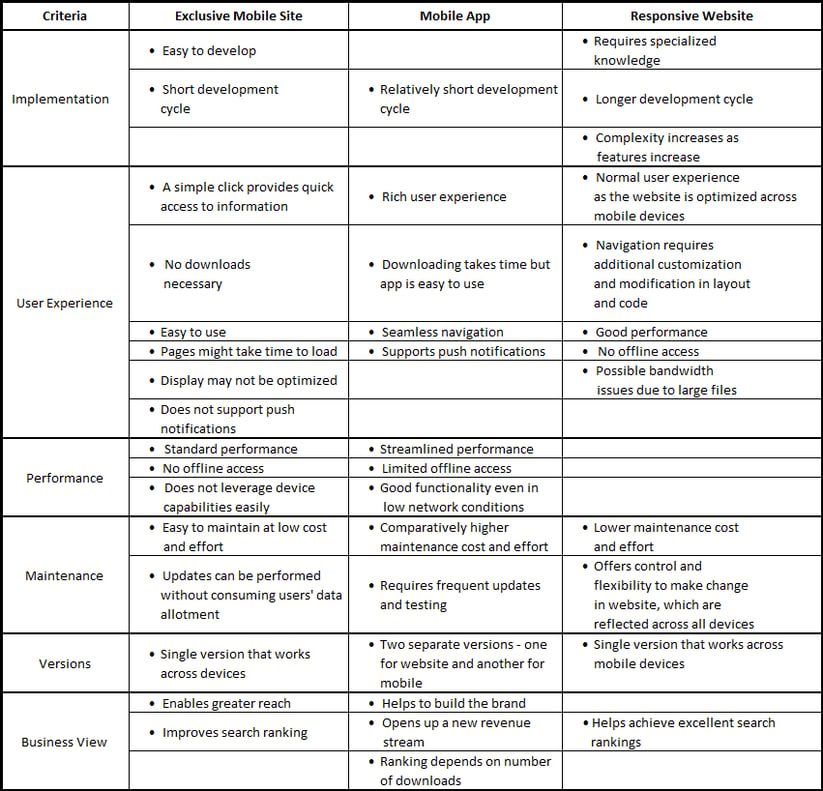
Careful analysis is required to make sure you use the right approach to meet your requirements. Let's look at a comparison summary:
Choose Wisely
Depending on your business and the kind of user base you are targeting, leveraging the right mobile strategy can make or break your organization. If you want to provide easy and quick access to information without making users download an app, then an exclusive mobile site will help get you all the traffic you need. If a rich user experience with seamless navigation and a quicker implementation is what you're looking for, then a mobile app is your best bet. And if you are looking to spend less money and effort in maintaining your mobile presence, while at the same time improving your SEO rankings, then a responsive website is ideal. In fact, Google recommends responsive web design because having a single URL for desktop and mobile sites makes it easier for Google to discover content and for Google’s algorithms to assign indexing properties to content. Choosing wisely is key to an efficient mobile presence.
Do you have a mobile-first strategy? Use this mobility scoping tool at no cost which allows you to complete a self-assessment, prioritize functions to mobilize, and think through critical factors that will eventually help you define enterprise mobility requirements.

|
|
About the Author - Neha Kumar Neha Kumar is a digital media evangelist and marketing professional. She overlooks Indusa’s content management, social media, online events, email marketing, blogs, digital campaigns, lead generation and inside sales activities on a broader scale.
Contibuting Author: Malavika Nityanandam |